
Introduction
How to sell custom software development services can seem daunting, but with the right approach, it becomes much more manageable. Understanding key elements—like identifying customer pain points, offering customized solutions, and aligning with decision-makers—sets the foundation for your success.
Here's a quick overview:
- Understand Customer Pain Points: Know the specific challenges and needs of your target customers.
- Highlight the Value of Customization: Show how custom solutions uniquely solve problems.
- Align with Decision Makers: Build relationships and trust with those who make purchasing decisions.
Understanding customer pain points is crucial. Businesses often seek custom software because off-the-shelf solutions don't fully meet their needs. Careful attention to what they require helps tailor your services effectively.
The value of customization can't be overstated. Custom software can offer a quick ROI by providing specific features that help clients achieve their unique business goals. Emphasizing this value helps clients see the benefits beyond just features.
Aligning with decision-makers involves building trust and demonstrating expertise. These stakeholders need confidence that your solutions will deliver measurable results quickly.
For a detailed breakdown and more practical tips, stay with us through the rest of the article.
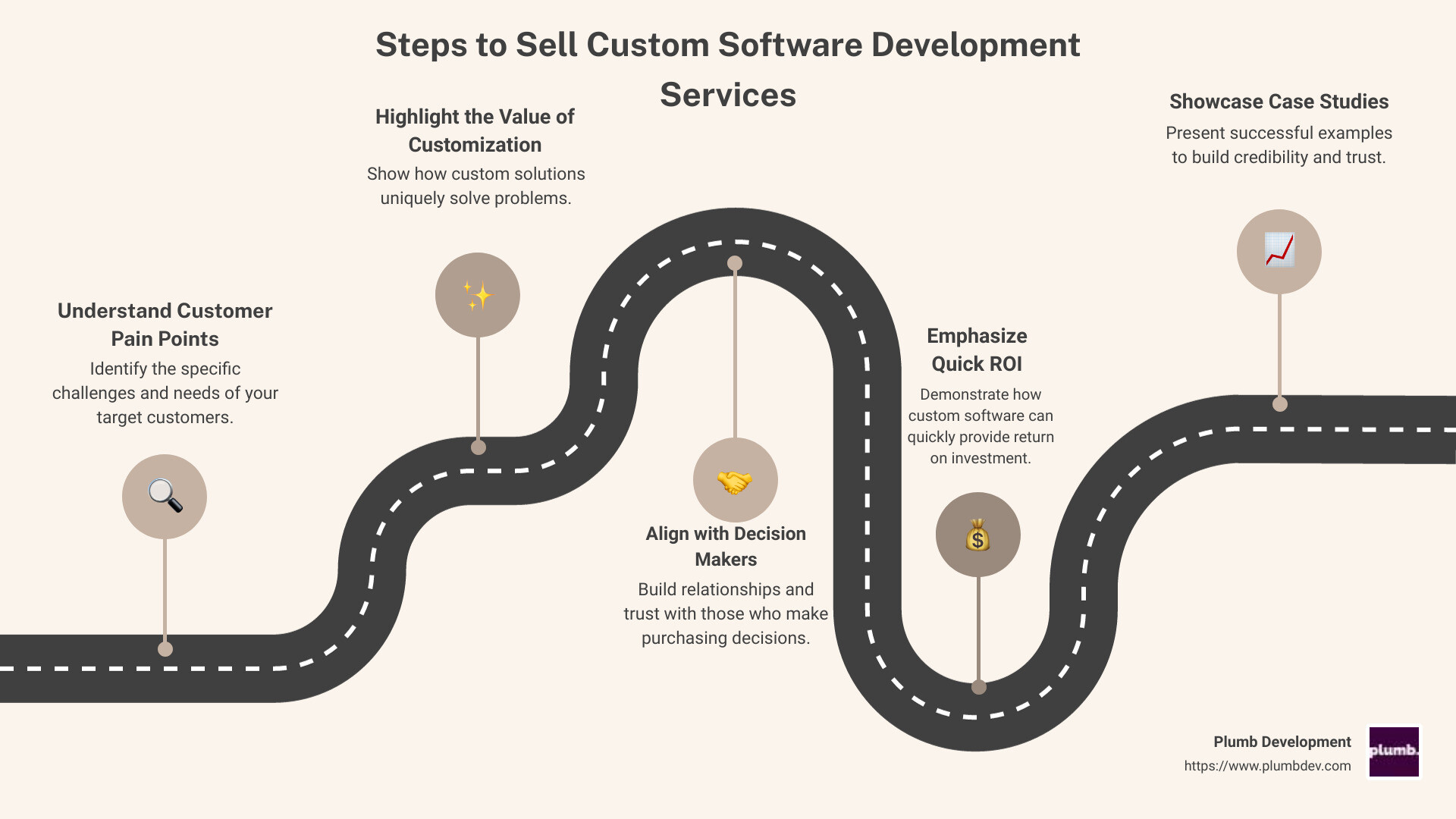
The infographic should include the following items:1. Understand Customer Pain Points2. Highlight the Value of Customization3. Align with Decision Makers
Understanding Your Target Market
Market Research
Before you can effectively sell custom software development services, you need to understand your target market. Start by conducting thorough market research. This involves identifying the industries that could benefit the most from your services. Look for sectors that are experiencing growth or undergoing digital transformation, as they are more likely to invest in custom software solutions.
For example, if you specialize in developing healthcare software, research the latest trends and challenges in the medical industry. Understand the regulations, pain points, and technological needs specific to healthcare providers.
Industry Needs
Each industry has unique needs and challenges. Tailor your approach to address these specific concerns. For instance, financial institutions may need secure and compliant software solutions, while retail businesses might focus on improving customer experience through e-commerce platforms.
Case Study: A software development company successfully targeted the logistics industry by offering custom solutions that optimized supply chain management. They highlighted their expertise in reducing operational costs and improving efficiency, which resonated with potential clients in that sector.
Pain Points Identification
Identifying the pain points of your potential clients is crucial. Pain points are specific problems that businesses face and are actively looking to solve. Once you know these, you can position your services as the solution.
Example: If you discover that many small businesses struggle with managing customer data, you can offer a custom CRM solution that addresses this issue. Highlight how your software can streamline data management, improve customer relationships, and ultimately boost sales.
Target Audience for Software Company
Defining your target audience involves narrowing down the types of businesses and decision-makers you want to reach. This could be based on company size, industry, or even geographic location.
For example, you might target mid-sized manufacturing companies that need automation solutions. Or, you could focus on startups looking for MVP (Minimum Viable Product) development.
Pro Tip: Use tools like Google Analytics and social media insights to gather data about your website visitors. This can help you better understand who is interested in your services and refine your target audience accordingly.
Practical Steps
- Conduct Surveys and Interviews: Engage with potential clients to gather insights about their needs and challenges.
- Analyze Competitors: Look at what your competitors are offering and identify any gaps in the market that you can fill.
- Utilize Online Tools: Use keyword research tools to understand what potential clients are searching for. This can help you tailor your messaging and services to meet their needs.
By thoroughly understanding your target market, you can craft a more effective sales strategy that resonates with potential clients and sets you apart from the competition.
Next, let's dive into how to craft a sales strategy that aligns with these insights and effectively engages your target audience.
Crafting Your Sales Strategy
Creating a sales strategy for custom software development services involves a few key steps. Let's break it down.
Engage Need-Aware Prospects
First, focus on engaging prospects who already recognize their need.
When selling software services, you’re not selling a commodity like popsicles. You’re offering a solution to complex business problems. If a potential client doesn’t see a need, move on.
Example: Imagine you’re talking to a manufacturing company that’s struggling with outdated inventory management. They know they have a problem. Your job is to show how your custom software can solve it.
Discuss Budget Early
Don’t shy away from budget talks early in the conversation. It’s better to find out sooner rather than later if the client’s budget aligns with your pricing.
Why? If you’re not in the same ballpark, why waste time? This helps both parties avoid unnecessary effort.
Tip: Ask open-ended questions about their budget expectations. This can also reveal how critical the project is to them.
Adjust Your Approach
Tailor your pitch based on who you’re talking to. Understand their role and what they care about.
- Technical Stakeholders: Focus on the technical benefits and how your solution integrates with their existing systems.
- Business Stakeholders: Emphasize ROI, efficiency improvements, and how your solution will impact their bottom line.
Manage Expectations
Set clear expectations from the start. This includes timelines, deliverables, and potential challenges.
Story: A software development firm once promised a client a complex CRM system in two months. They didn’t account for the client’s slow feedback loop, resulting in delays and frustration. Clear expectations could have avoided this.
Scope Management
Scope creep is a common challenge in software development. It’s crucial to manage it effectively.
How? Define the project scope clearly and stick to it. Any changes should go through a formal change request process.
Fact: According to a study, projects that manage scope changes effectively are 30% more likely to succeed.
By following these steps, you can craft a sales strategy that not only engages prospects but also sets the stage for a successful partnership.
Next, let's explore effective marketing strategies to attract and convert prospects into loyal clients.
Marketing Strategies for Custom Software Services
When it comes to marketing custom software development services, a well-rounded strategy is key to attracting and converting prospects. Here are some effective approaches:
Digital Marketing Plan
A comprehensive digital marketing plan is essential. It should include a mix of SEO, content marketing, social media, and paid advertising.
Pro Tip: Don’t try to master every marketing method. Focus on 2-3 that suit your business best. For example, Plumb Development leverages both SEO and content marketing to attract quality leads.
Content Marketing
Content marketing is about providing valuable information to your audience. This builds trust and positions you as an expert in your field.
Case Study: A software development company increased their leads by 40% by publishing detailed case studies and how-to guides on their blog. Source
Tips:- Publish blog posts, whitepapers, and case studies.- Use videos to showcase your team's expertise and project successes.- Offer free consultations or webinars to engage potential clients.
SEO for Software Companies
Search Engine Optimization (SEO) is crucial for improving your website's visibility on search engines. This helps attract organic traffic and potential clients.
Fact: Companies that invest in SEO see a 14.6% conversion rate from organic leads. Source
Tips:- Optimize your website with relevant keywords.- Create high-quality, informative content.- Use backlinks to boost your site's authority.
Social Media Engagement
Social media platforms are excellent for building relationships with potential clients. They also provide a platform to showcase your expertise and success stories.
Example: Plumb Development uses LinkedIn to share industry insights and engage with potential clients.
Tips:- Share your blog posts, case studies, and client testimonials.- Participate in relevant industry groups and discussions.- Use paid social media ads to target specific audiences.
Inbound vs Outbound Marketing
Inbound marketing focuses on attracting customers through valuable content and SEO, while outbound marketing involves direct outreach, such as cold emails and ads.
Pro Tip: Combine both strategies for maximum impact. Use inbound marketing to attract leads and outbound marketing to reach out to high-value prospects.
Quote: "The best marketing doesn’t feel like marketing." – Tom Fishburne
By implementing these strategies, you can effectively market your custom software development services and attract high-quality leads.
Next, we’ll dive into practical tips for selling custom software development services.
Selling Custom Software Development Services: Practical Tips
Selling custom software development services can be challenging, but with the right approach, you can increase your chances of success. Here are some practical tips to help you navigate this complex process.
Engage with a Need
Focus on those who recognize a need. Unlike consumer products, custom software solutions require a pre-existing need. If a potential customer doesn't see the problem, convincing them to invest will be an uphill battle.
Example: If a company is struggling with inefficient internal processes, they may not realize the extent of the problem. Your job is to highlight how your software can solve this issue. But if they don’t agree, move on.
Understand the Business Problem Size
Assess the scale of the problem. Determine how significant the issue is for the business. Ask questions like:
- What is this problem costing them in terms of inefficiencies, risks, or mistakes?
- How critical is this software to their operations?
Case Study: A retail company faced frequent stock-outs due to poor inventory management. By implementing a custom software solution, they reduced stock-outs by 30%, significantly improving their customer satisfaction and sales.
Discuss Budget Early
Don’t shy away from budget talks early on. Understanding the budget helps ensure you're on the same page. It saves time and avoids mismatched expectations.
Tip: Ask questions like, “Is this project well-funded or are you working with a limited budget?” This helps you gauge if the project is viable for both parties.
Technical vs. Non-Technical Approach
Adjust your communication based on your audience. When talking to technical stakeholders, dive into the specifics. For non-technical stakeholders, focus on the business benefits and ROI.
Example: When presenting to a CTO, discuss the software architecture and integration capabilities. When talking to a CEO, highlight how the software will streamline operations and boost revenue.
Predicted Customer Lifetime Value (CLV)
Estimate the potential long-term value of the customer. Understanding the predicted CLV helps in prioritizing leads and tailoring your approach.
Fact: Companies with a higher CLV are worth investing more time and resources into, as they offer more significant long-term benefits.
Company Fit Assessment
Be realistic about the fit. Not every lead will be a good match for your services. Assess if your company is the right fit for their needs.
Questions to ask:- Does the project align with your expertise?- Can you meet their expectations and timeline?
Quote: “It’s better to have a few high-quality clients than many that don’t fit well with your services.”
Quick Follow-Up
Follow-up faster than you think you should. Quick follow-ups show that you’re proactive and serious about the project.
Tip: Set reminders to check in with leads within 24-48 hours after initial contact. This keeps the conversation fresh and demonstrates your commitment.
By implementing these practical tips, you can effectively sell your custom software development services and build strong, lasting relationships with your clients.
Next, we’ll address some frequently asked questions about selling custom software development services.
Frequently Asked Questions about Selling Custom Software
How to identify the target market for custom software services?
Identifying your target market is the first step in how to sell custom software development services effectively. Begin by conducting thorough market research to pinpoint industries that benefit most from custom solutions.
Market Research Tips:- Identify Industry Needs: Look for sectors with unique challenges that off-the-shelf software can't solve. For example, healthcare, finance, and e-commerce often need tailored solutions.- Analyze Pain Points: Understand common problems within these industries. For instance, construction companies may struggle with project management and documentation.- Target Audience Profiling: Create detailed profiles of potential customers. Know their business size, decision-making process, and budget constraints.
Case Study: One of our clients, a mid-sized construction firm, needed a specialized project management tool. By understanding their specific pain points, we developed a custom solution that significantly improved their operational efficiency.
What is the average cost of custom software development?
The cost of custom software development varies widely based on several factors:
- Project Complexity: Simple applications with basic features cost less, while complex systems with advanced functionalities are more expensive.
- Development Time: Longer development timelines increase costs. Projects requiring extensive research, testing, and iterations will be pricier.
- Team Expertise: Highly skilled developers demand higher rates. However, their expertise can result in a better product.
- Technology Stack: The choice of technology impacts cost. Cutting-edge technologies might be more expensive but offer long-term benefits.
Fact: According to TechTask, custom software development can range from $10,000 for simple projects to over $500,000 for complex enterprise solutions.
How to engage potential customers effectively?
Engaging potential customers is crucial in selling custom software development services. Here are some actionable tips:
- Ask Open-Ended Questions: Start conversations by asking about their current software solutions and challenges. This helps uncover their specific needs.
- Example: "Can you tell me about the challenges you're facing with your current project management tool?"
- Provide Value Early: Offer free consultations or small-scale demos to showcase your expertise. This builds trust and demonstrates your capability.
- Example: Conduct a quick test job to prove your team's skills and fit for the client's needs.
- Use Success Stories: Share case studies and testimonials from past clients to validate your expertise.
- Example: "We helped a healthcare provider reduce administrative workload by 30% with our custom software solution."
- Follow-Up Promptly: Reach out within 24-48 hours after initial contact to keep the conversation fresh and show your commitment.
By understanding your target market, knowing the cost factors, and engaging effectively, you can master the art of selling custom software development services.
Next, we’ll conclude with Plumb Development's unique approach to empowering clients in the digital landscape.
Conclusion
At Plumb Development, we believe that empowering our clients in the digital landscape is more than just delivering a product—it's about creating a seamless bridge between strategy and execution. Our approach is designed to ensure that each project not only meets but exceeds client expectations.
Bridging Strategy and Execution
We start by deeply understanding the unique needs and challenges of each client. Through comprehensive consultations, we identify the pain points and opportunities for improvement. This strategic insight forms the foundation of our custom software solutions.
Our process involves:
- Collaborative Planning: We work closely with clients to outline clear objectives and timelines. This ensures that all stakeholders are aligned from the get-go.
- Agile Methodologies: By employing agile development practices, we remain flexible and responsive to changes, ensuring that the final product is both robust and adaptable.
Focus on UI/UX Design
A key differentiator in our approach is our unwavering focus on UI/UX design. We understand that a well-designed interface can significantly enhance user experience and adoption rates.
- User-Centered Design: Our team of designers and UX experts prioritize the end-user experience. We create intuitive interfaces that are not only visually appealing but also easy to navigate.
- Iterative Testing: We believe in continuous improvement. Through iterative testing and feedback loops, we refine the design to meet user needs effectively.
Empowering Clients in the Digital Landscape
Our ultimate goal is to empower our clients to thrive in the digital age. We do this by providing solutions that are not only technically sound but also strategically aligned with their business goals.
- Scalable Solutions: We build software that grows with your business. Whether it's handling increased user loads or integrating new features, our solutions are designed to scale.
- Ongoing Support: Our commitment doesn't end with the delivery of the product. We offer continuous support and maintenance to ensure long-term success.
For more details on how we can help your business leverage custom software solutions to achieve its goals, visit our custom software application development services page.
By focusing on these core principles, Plumb Development ensures that each project not only meets the immediate needs of our clients but also sets them up for long-term success in the digital landscape.